In government, effective communication may look very different than what we learned in school. Our instructors may have valued fancy words and complex sentences, but such language won’t help the elderly apply for social services benefits. And internal jargon won’t help colleagues on other teams understand what we need.
The public sector — indeed, all of us — needs to use plain language. It means having wording, structure and design that are so clear that our intended audience can easily find what they need, understand what they find, and then use that information.
“Everything is about the reader,” said plain language expert Julie Clement during a recent GovLoop Community of Practice session. “If you don’t know who the reader is, if you don’t know why the reader might come to your document, what they are looking for, what they need, then you will never, ever get your message across.”
Circumstance is important, too, she said: The same reader may respond to the same communication differently depending on situation. For example, someone scheduled for surgery could leisurely, thoughtfully review waiver forms several weeks in advance. That person’s response to the information likely will be much different, however, when presented with the exact same forms in an emergency room, dealing with a life-or-death crisis.
Plain language does allow for technical terms, Clement stressed — the legal community must use legal terminology when addressing other lawyers in their audience, for instance — and you don’t necessarily need short, choppy sentences. Those myths are sadly pervasive, the idea that you’re only “skimming the surface” with simpler wording.
Beyond verbiage, plain language is influenced by visual cues: strategic use of white space, incorporating subheadings and bullets, inclusion of charts and graphics, and the like. Digital.gov can help you clarify and declutter your communication and offers an exceptionally helpful, multipart plain language guide that’s relevant for any public entity.
For those of us who fondly remember the “sophistication” of our school essays, the guide offers this special caution: “While there is generally no problem with being expressive, most federal writing has no place for literary flair. People do not curl up in front of the fire with a federal regulation to have a relaxing read.”
Indeed, they do not.
For more plain language guidance, check out these GovLoop resources:
- 2-Minute Video: Plain Language Explained
- Worksheet: Use Plain Language to Improve Communication
- On-Demand Video: How Plain Language Can Improve Your CX
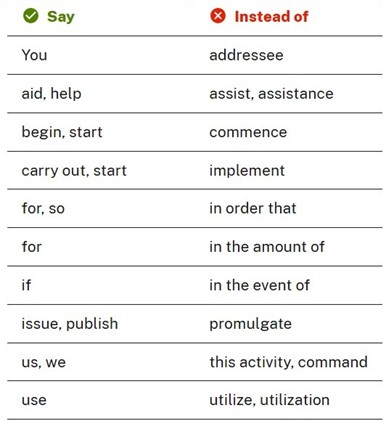
Below are simpler alternatives to words that commonly appear in government writing.