



When Dan Cronin became Oklahoma’s CIO and Chief Transformation Officer in January 2025, he discovered that the state’s technology foundation was solid but outdated. The question was how to go about modernizing it.
Given recent advances in AI, automation, analytics and other areas, the opportunities to innovate seemed limitless. But the state’s budget was not. So, in developing a new IT strategy, Cronin focused on technology and tactics that would deliver tangible benefits for the state, its employees and its residents.
“I’m a big believer in outcome-based results,” he said. “We don’t want to do IT just to do it, just because it might be fun or cool for tech staff. There has to be value to doing it.”
An outcome-based approach balances innovation with sound financial stewardship, he said. Cronin and Tai Phan, the state’s Chief AI and Technology Officer, frame their strategy in terms of accountable innovation. For IT experts, this requires new thinking.
“It’s one thing to know how to architect something,” Phan said, “but why do you need that design in the first place? Is it the right tooling? And do our agencies and citizens care about it at the end of the day? If we can’t clear those basic criteria, we’re not being responsible stewards.”

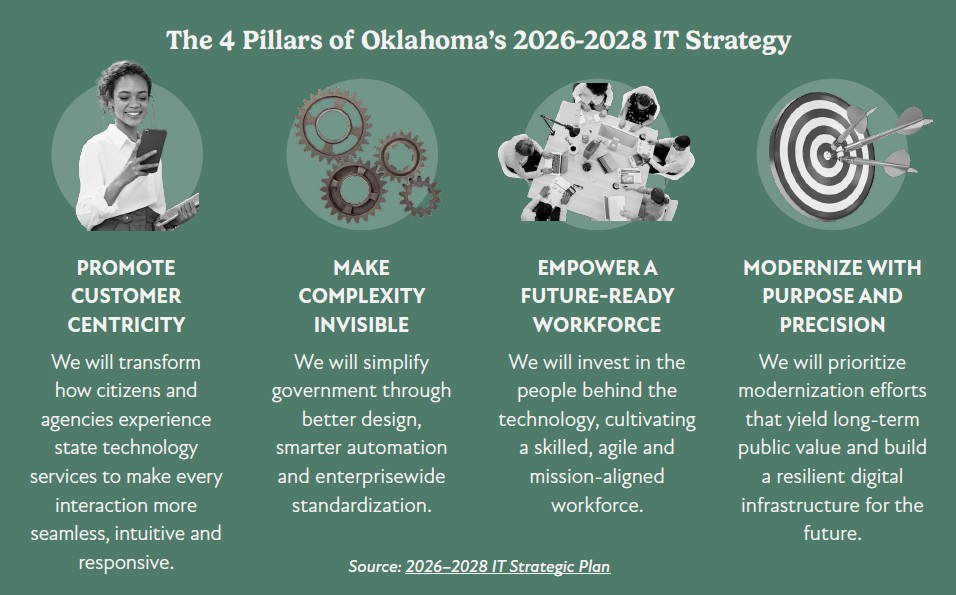
A Customer-Centric Approach
Customer-centricity not only is the first pillar of the IT strategy, but also a through‑line across the remaining pillars. Each section of the strategy clearly explains how the pillar benefits both state residents and agencies. But rather than focusing on individual applications or services, the strategy emphasizes the digital infrastructure needed to support those efforts at scale.
The most important measure of success is the customer’s experience, Cronin said.
“That standard applies to both our internal agency customers all the way to citizens in the farthest reaches of our rural counties,” he said. “We want the experience to be as stellar as possible. It’s up to our technical capabilities to alleviate their headaches and pain points.”
As part of this customer-centric focus, Oklahoma is changing its approach to IT initiatives, shifting from working on a series of projects to a more coordinated planning effort.
For example, as in many states, Oklahoma’s digital services are organized around life milestones, such as getting married, having a child or retiring. Rather than looking at each in isolation, though, the IT team wants to provide a cohesive experience, Phan said. “We’re no longer thinking about designing a transaction, but instead about the citizen journey,” he said.
Making Complexity Invisible
Another priority is masking the complexity of the underlying digital infrastructure. As services and applications become more sophisticated and expansive, Cronin doesn’t want the user experience to suffer. Instead, he says a digital service should be like the Apple iPhone, which reset user expectations for technology: No need to fiddle with it or worry about it. It just works.
A lot of effort goes into that. Developers talk about the importance of dogfooding a product — that is, using a product internally as part of quality testing before releasing it. (The term comes from a Kal Kan executive who ate his company’s dog food at a shareholder meeting.) That’s the standard for the Oklahoma team.
“Whenever we turn something on or light it up for the entire state, we dogfood it in-house first — we beat it up, test it, get new sets of eyes on it,” Cronin said. “We make sure that experience is going to meet expectations or we don’t roll it out.”
The Empathy Solution
Once a product is released, the feedback loop begins. The developers track performance data, follow up on troubleshooting tickets and contact customers. They know how well a system is performing behind the scenes, but is that reflected in the user’s experience? If not, they try to figure out what went wrong and fix it.
That’s the human side of being outcome-oriented, which can’t be driven by an IT strategy. “You need a team that’s willing to lean in, listen, have empathy for the environment around them, and wants to make things better,” Cronin said.
The challenge is that tech experts can get focused on solving a problem before they fully understand the outcome their customers are trying to achieve. They need to build a relationship with a customer before they build a solution. “The tech side is easy,” he said. “It’s the people side that’s a cultural adjustment for us.”
Investing in Trust
Both Cronin and Phan came to Oklahoma from the private sector, where the concept of accountable innovation has a different twist. For commercial firms, accountability is primarily about revenue, said Phan, while for agencies, it is primarily about trust.
That’s because the stakes are so much higher. Operational decisions agencies make can determine whether a family has food on the table, whether someone gets access to the care they need or how effective an emergency response will be. “As we modernize, we have to make sure that we don’t lose track of that, because trust is the currency that drives that decision,” Phan said.
Agencies can put a lot of money and energy into modernizing their operations, but if those investments don’t result in better outcomes, it’s just wasted motion, said Cronin. “That’s one of the things that I always share with my team: Never mistake motion for progress,” he said. “You have to be smart with what you’re doing and why you’re doing it. Just spinning your wheels is not progress.”
This article appears in our recent guide “Building a Better Digital Experience.” Download the guide for more insight into how agencies are rethinking IT modernization through the lens of improved digital experiences.