


Artificial intelligence is no longer a future conversation for government teams. It’s already embedded in daily work, whether leaders realize it or not.

Teams are using AI to draft communications, summarize reports, and analyze data faster than ever before. But here’s the problem: Most of this activity isn’t translating into meaningful outcomes.
There’s a growing gap between using AI and operationalizing AI.
Activity Isn’t Impact
Across agencies and government contractors, AI adoption is happening in pockets. One team experiments with prompt tools. Another tests automation. A third is exploring policy implications.
What’s missing is cohesion!
AI is being treated like a tool instead of what it actually is: a capability that should be embedded into how work gets done.
The result? More output, but not necessarily better decisions, faster operations, or improved constituent outcomes.
Where AI Is Actually Driving Value
When implemented correctly, AI isn’t just a productivity boost. It becomes an operational advantage.
We’re seeing real impact in three areas:
1. Decision Support
AI can synthesize large volumes of data into usable insights, helping leaders move faster and with more confidence.
2. Workflow Optimization
Routine processes like reporting, documentation, and internal communications can be streamlined, reducing manual effort and freeing up time for higher-value work.
3. Workforce Enablement
AI isn’t replacing employees. It’s elevating them. When teams understand how to use AI effectively, they become more efficient, more strategic, and more adaptable.
But none of this happens by accident.
What Leaders Are Getting Wrong
Most organizations aren’t failing because of the technology. They’re failing because of how they approach it. Here are the biggest gaps:
- No clear use cases tied to mission outcomes
- No structured training on how to actually use AI tools
- No governance or framework guiding adoption
- Too much experimentation, not enough implementation
Many teams are stuck in what I call the “pilot phase trap.” They test AI, but never embed it where performance actually happens.
Even at the leadership level, there’s often a disconnect between policy and execution. Federal directives outline what should happen, but teams lack a clear path to make it operational.
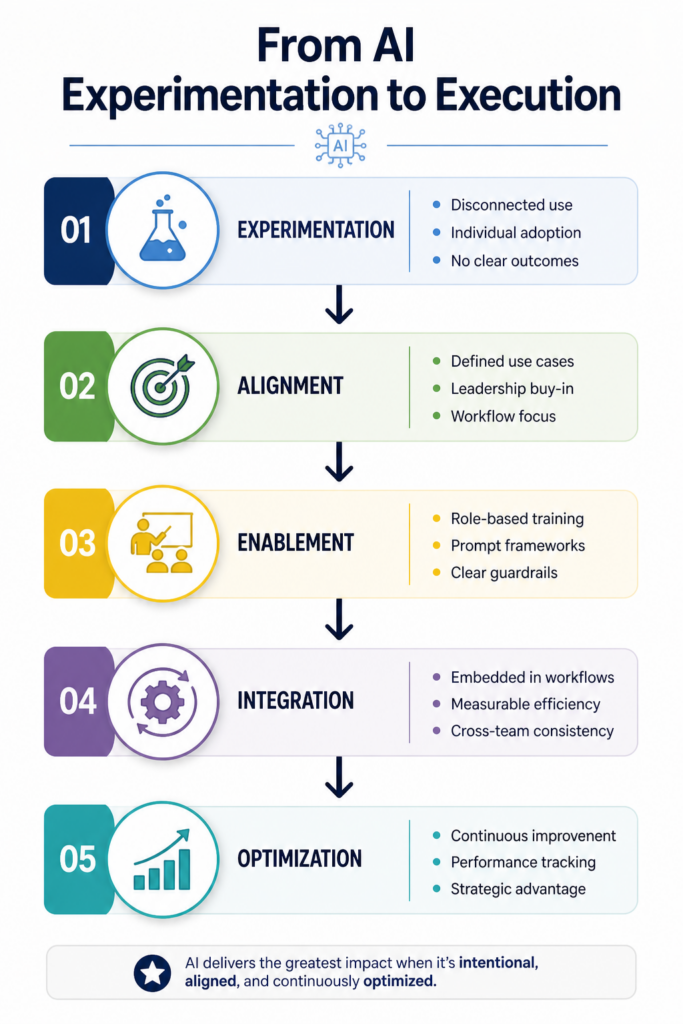
Moving From Experimentation to Execution
AI adoption doesn’t need to be overwhelming, but it does need to be intentional.
The shift happens when organizations:
- Identify high-impact workflows where AI can drive measurable value
- Assess their current AI maturity, risks, and gaps
- Train teams on practical, role-based use of AI
- Establish governance structures that support responsible, secure implementation
Organizations don’t need more tools. They need clarity.
That’s why structured approaches like AI readiness diagnostics and targeted workshops are becoming essential. They help teams move from scattered experimentation to aligned, mission-driven execution by identifying where AI actually drives outcomes and how to implement it responsibly.
What This Looks Like in Practice
In one recent engagement with a large federal organization, teams had already begun experimenting with AI tools across departments. On paper, adoption appeared strong. In practice, usage was inconsistent and often disconnected from operational goals.
Different teams approached AI differently. Some used it for drafting communications. Others explored data analysis or reporting support. Leadership could see activity happening across the organization, but lacked visibility into whether those efforts were driving meaningful outcomes.
The challenge wasn’t access to AI. It was alignment.
Like many large organizations, teams operated in silos, with no shared framework for implementation, governance, or measurement.
The first step was assessing how AI was currently being used and identifying where it intersected with high-value workflows. From there, a focused set of use cases was prioritized around operational efficiency, including content development, internal reporting, and decision support.
Rather than delivering broad, generic AI training, the approach centered on targeted, role-based sessions tailored to how individual teams actually worked. This included practical prompt frameworks, governance considerations, and clear guidance on where human oversight remained essential.
Within weeks, the shift was noticeable.
Teams moved from ad hoc experimentation to more structured, intentional application. Processes that previously took hours became significantly more streamlined. More importantly, leadership gained greater visibility into where AI was improving efficiency, where adoption gaps still existed, and where further refinement was needed.
The outcome wasn’t simply increased AI usage. It was measurable progress toward more efficient operations, stronger internal alignment, and better-informed decision-making.
The Bottom Line
AI will not replace government teams. But teams that understand how to embed AI into their operations will outperform those that don’t.
The advantage won’t come from who uses AI first. It will come from who uses it with intention.
Raitchele Arnell is the CMO of ArtForm Business Solutions, a women-owned digital agency supporting government contractors, enterprise organizations, and public-sector initiatives. She specializes in AI adoption, market intelligence, strategic communications, and modernization strategies for highly regulated and mission-driven industries. Her work spans cybersecurity, healthcare modernization, emergency communications, critical infrastructure, and federal technology initiatives. Known for helping organizations rethink how marketing supports mission outcomes, Raitchele focuses on the intersection of AI, operational efficiency, audience intelligence, and trust-driven communications.



Leave a Reply
You must be logged in to post a comment.