


Many grant applications require inclusion of a logic model, and even if you are familiar with them, a refresher may be beneficial. Logic models are visual representations that explain how a program or initiative would function and identify major components, without including all relevant information. The models help people collaborate by ensuring that everyone has a common understanding of the program. They also serve as reference points.
The W.K. Kellogg Foundation defines a logic model as: “a picture of how your organization does its work – the theory and assumptions underlying the program. A program logic model links outcomes (both short- and long-term) with program activities/processes and the theoretical assumptions/principles of the program.”
The following is an example logic model. It is for development of a potential Neurodiversity Advocacy Coalition, which would try to help neurodivergent people.
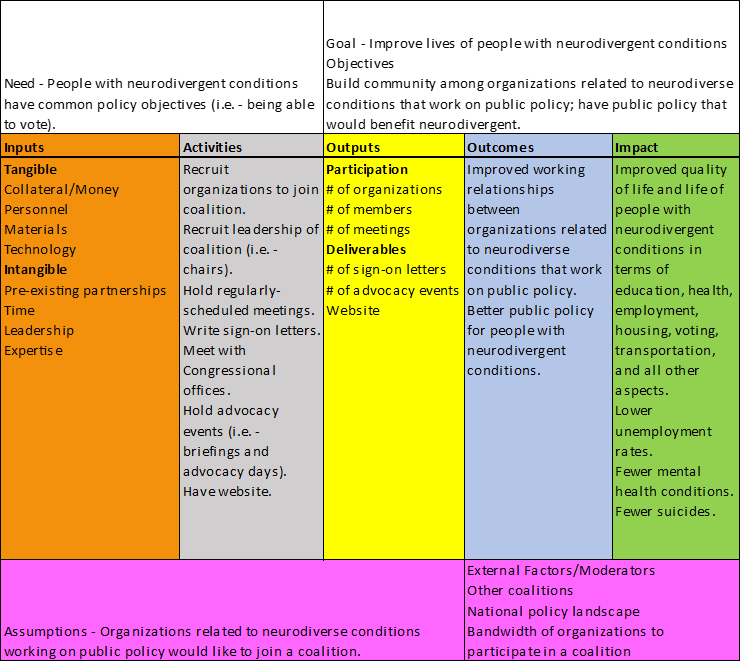
Logic models can be useful in a variety of settings:
- Planning – The models can determine partnership and outcome targets, be used to secure funding, estimate timelines, focus conversation, and more.
- Implementation – Employees can ensure that the programs are run as they are supposed to. They can also make changes.
- Orientation of employees and others – Logic models can provide an overview of the program for new people. Individuals can learn their responsibilities and signs that the program is functioning properly.
- Evaluation – Logic models can be used to write reports, describe programs, and help identify achievements.
- Advocacy – Logic models can be used to explain why an initiative will be successful and to support the allocation of resources.
Logic models vary in form. Their major parts are:
- “Inputs” or Resources – This part consists of the materials that are used in the program. The program could not happen without resources. Inputs can be tangible (i.e., space) or intangible (i.e., knowledge).
- “Activities” – This section includes the program’s actions.
- “Outputs” – This describes indicators of the program’s functioning.
- “Effects” (or “Outcomes”) – This part explains the program’s results. Sometimes, the effects are divided into short-term (“changes in knowledge, skills, and/or attitudes”), medium-term (“changes in behavior or action”), and long-term (“changes in condition or status of life”).
Logic models sometimes also include at least some of the following:
- “Purpose”: the program’s goal
- “Context”: the conditions (i.e., political, economic) where the program is situated, and related to “External Factors/Moderators”
- “Constraints” or Barriers: potential problems that might get in the way of the program
- “Assumptions”: beliefs about the program’s operations and people connected to it
If the program is just an idea (which often is the case when it’s part of a grant application), those sections describe expected aspects (i.e., effects).
- Compile relevant information, such as reports, documents, and more.
- Determine your agency’s ability to create a logic model. Employees could write the model and/or your agency could hire a consultant who specializes in evaluation.
- Talk with people who are connected with your agency’s work. You can hold workshops and/or small group conversations, interview people, or both.
- Choose who should write the model. A few employees could co-draft it and ensure that the draft logic model makes sense. If the logic model’s information becomes complicated, then your agency may create a set of related models. Your agency may have to write multiple drafts of the logic model.
- After gaining feedback, your agency can finalize the logic model for the time being.
Logic models are “living documents” that should be revised to ensure that they accurately describe your agency’s work and can be updated every year, perhaps at your agency’s retreat.
Logic models help make sure that people understand programs. Even if they are not required, they could still be useful to write and use.
Miriam Edelman, MPA, MSSW, is a Washington, D.C.,-based policy professional. Her experience includes policy work for Congress. Miriam’s undergraduate degree is from Barnard College, Columbia University, with majors in political science and urban studies. She has a master’s in public administration from Cornell University, where she was inducted into the national honorary society for public administration. She has a master’s of science in social work (focusing on policy) from Columbia University. She is a commissioner of the DC Commission on Persons with Disabilities. Miriam aims to continue her career in public service. She is especially interested in democracy, civic education, District of Columbia autonomy, diversity, health policy, women’s issues, and disabilities.


Leave a Reply
You must be logged in to post a comment.