
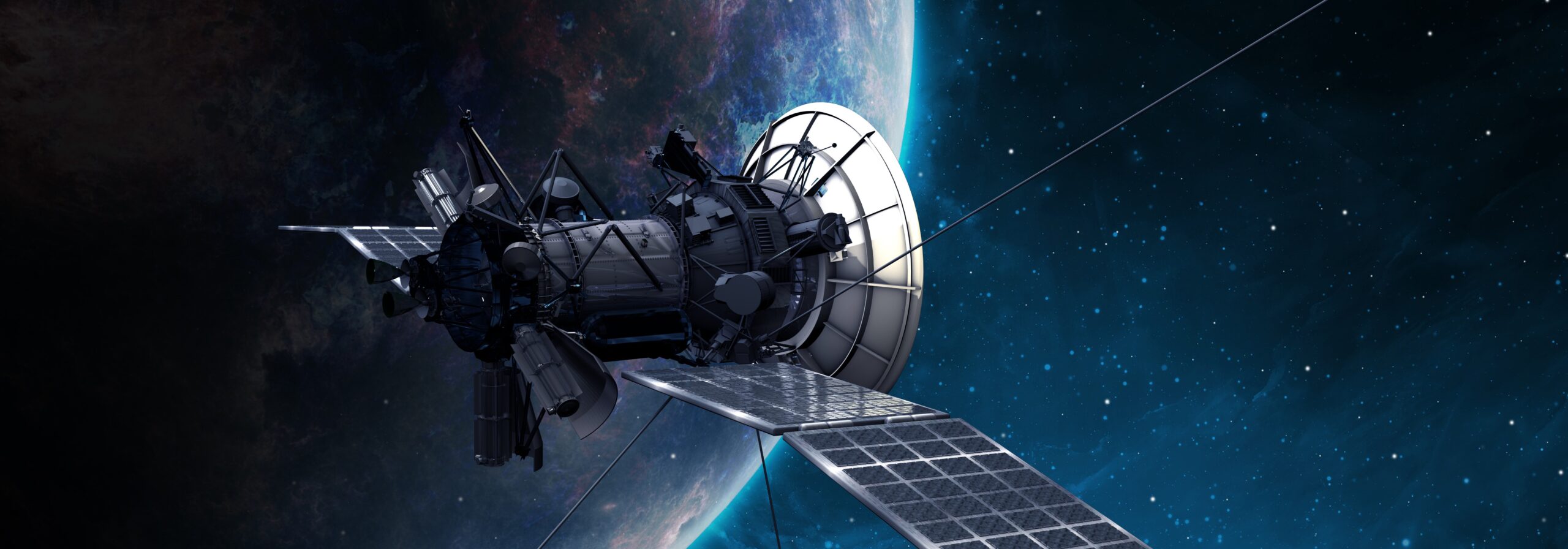

The future of cybersecurity is no longer confined to terrestrial networks. It is increasingly orbital.
A recent MITRE paper, Development of Cybersecurity Norms for Space Systems, by Mr. Sam Visner and Dr. Sharfman, highlights a growing reality: Space systems are becoming deeply embedded within global economic, defense, communication, and infrastructure ecosystems.

This evolution fundamentally changes the strategic risk equation for governments, critical infrastructure operators, and enterprise leaders. The discussion around cybersecurity in space is no longer theoretical. It is operational. And increasingly, it is tied directly to the future of artificial intelligence, compute dominance, cloud infrastructure, and energy resilience.
Space Is Becoming Critical Infrastructure
The paper outlines how the proliferation of satellites, commercial launch systems, and global communications platforms is transforming space into an extension of the world’s digital operating environment.
What was once the domain of governments and defense agencies now includes:
- commercial satellite constellations
- space-enabled cloud services
- GPS-driven agriculture and logistics
- global telecommunications
- autonomous systems
- financial timing systems
- Internet-of-Things ecosystems
- AI-enabled edge computing
The authors note projections that the global space economy could reach $1.4 trillion by 2030, with potentially 50,000 satellites in orbit. This matters because modern digital infrastructure increasingly depends on:
- persistent connectivity
- distributed compute
- low-latency communications
- precision timing
- and resilient global data movement
Space systems now underpin all five.
AI Changes the Strategic Equation
The conversation becomes even more significant when viewed through the lens of AI. Artificial intelligence is driving unprecedented demand for compute capacity, hyperscale cloud infrastructure, edge processing, low-latency communications, and continuous data exchange.
AI systems do not function in isolation. They depend on enormous digital ecosystems. As AI scales globally, orbital infrastructure increasingly becomes part of the AI enablement layer.
Satellite systems now support:
- cloud synchronization
- remote AI inferencing
- autonomous systems
- military intelligence
- precision agriculture
- maritime logistics
- smart infrastructure
- emergency response
The rise of AI-enabled autonomous operations also means disruption of satellite communications can rapidly cascade into operational disruption across multiple sectors simultaneously.
This is no longer merely an IT problem. It is a systemic operational resilience challenge.
Compute Is Becoming a National Power Asset
The race for AI supremacy is increasingly a race for compute dominance. Compute capacity now influences:
- economic competitiveness
- military modernization
- intelligence superiority
- scientific innovation
- industrial productivity
But compute requires infrastructure. And infrastructure requires connectivity, synchronization, cooling, physical protection, and increasingly…power.
Space systems are becoming tightly integrated with global compute architecture through:
- distributed cloud environments
- global broadband
- military command systems
- resilient communications layers
This means cyberattacks against space infrastructure may increasingly represent indirect attacks against AI ecosystems and national compute capability itself. The strategic implications are enormous.
Energy Is Quietly Becoming the Constraint
One of the least discussed dimensions of the AI race is energy. AI infrastructure consumes extraordinary levels of power.
Hyperscale data centers, advanced semiconductor manufacturing, high-performance computing clusters, and AI model training environments require vast energy resources and increasingly stable grid operations. At the same time:
- smart grids depend on satellite timing.
- energy logistics rely on GPS.
- distributed energy coordination requires communications resilience.
- emergency response systems increasingly leverage orbital data.
The MITRE paper notes that disruption of space systems could jeopardize critical national functions and economic operations.
That concern grows exponentially in an AI-driven economy where compute availability and energy continuity are becoming strategic national assets.
The convergence is now clear:
- AI → depends on compute
- Compute → depends on energy
- Energy → depends on resilient infrastructure
- Infrastructure → increasingly depends on space systems
Which means that space cybersecurity is becoming foundational to economic resilience.
The Norms Problem
The MITRE authors argue that traditional “deterrence by denial” approaches are insufficient because highly connected systems remain inherently vulnerable.
Instead, they emphasize the importance of international norms, deterrence mechanisms, and shared expectations regarding acceptable behavior in cyberspace and space operations.
This is critically important.
The global economy is rapidly building interdependence around orbital infrastructure before governance and operational norms are fully mature. Historically, societies often operationalize technology first and govern later. AI, cyber, and space convergence may compress that timeline dramatically.
The absence of clear international norms for cyber operations against space systems introduces escalating strategic uncertainty:
- What constitutes an act of war?
- What level of disruption triggers retaliation?
- How are commercial systems protected?
- Who is responsible for cascading failures?
- How should nations respond to gray-zone attacks?
These questions are no longer hypothetical.
The Emerging Leadership Imperative
Government leaders, CISOs, infrastructure executives, and policymakers should begin reframing space cybersecurity as part of enterprise resilience strategy. This requires:
- integrating orbital dependencies into risk assessments
- mapping AI and compute dependencies to space-enabled systems
- strengthening public-private coordination
- expanding cyber resilience exercises
- developing cross-sector continuity planning
- accelerating international cooperation around operational norms
The future competitive landscape will increasingly favor nations and organizations that can secure compute, stabilize energy, protect communications, and sustain trusted infrastructure ecosystems under disruption.
Space is no longer separate from the enterprise. It is becoming part of the enterprise operating environment itself.
And in the AI era, the protection of orbital infrastructure may ultimately become inseparable from the protection of economic stability, national resilience, and strategic advantage.
Dr. Rhonda Farrell is a transformation advisor with decades of experience driving impactful change and strategic growth for DoD, IC, Joint, and commercial agencies and organizations. She has a robust background in digital transformation, organizational development, and process improvement, offering a unique perspective that combines technical expertise with a deep understanding of business dynamics. As a strategy and innovation leader, she aligns with CIO, CTO, CDO, CISO, and Chief of Staff initiatives to identify strategic gaps, realign missions, and re-engineer organizations. Based in Baltimore and a proud US Marine Corps veteran, she brings a disciplined, resilient, and mission-focused approach to her work, enabling organizations to pivot and innovate successfully.



Leave a Reply
You must be logged in to post a comment.