
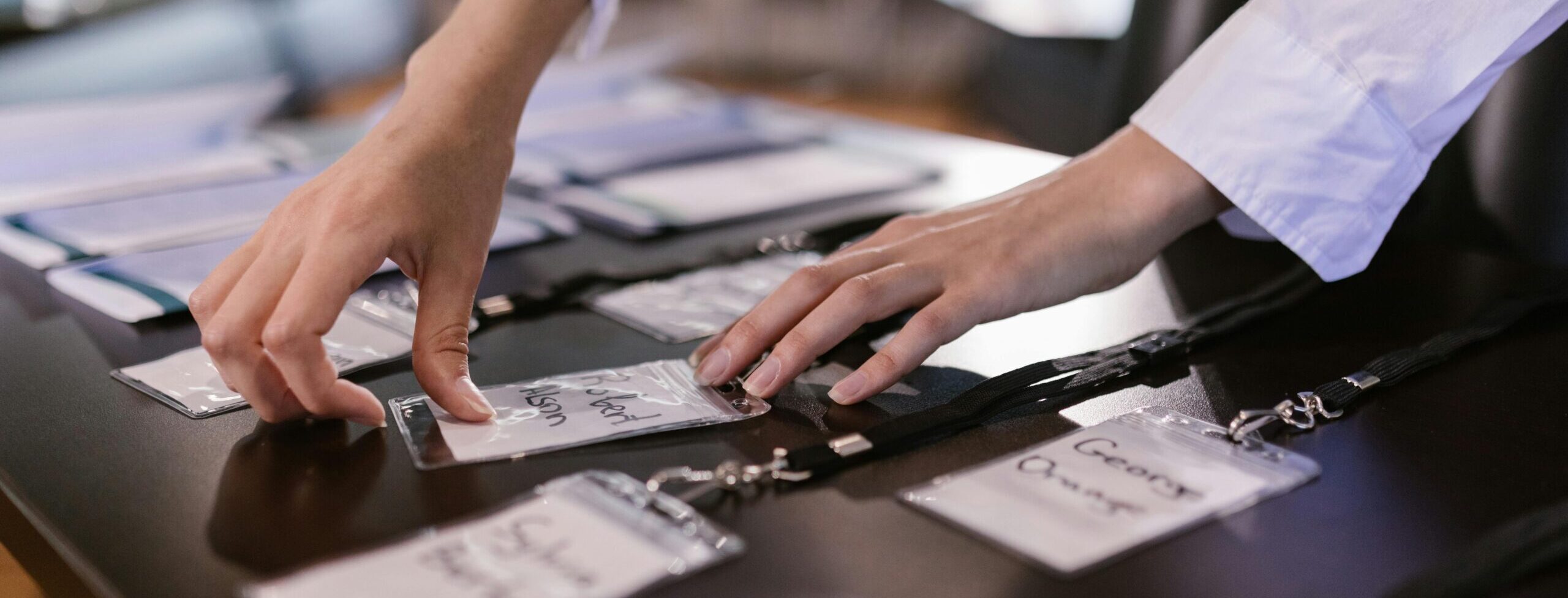

Congratulations! Your agency hosts events with widespread interest. Be prepared to handle many attendees. This piece focuses on registrations lists and coat checks, and while the information in this piece may seem basic and obvious, a refresher can always be helpful.

Registration Lists
If you choose to have paper sign-ins, organize the names of attendees in a particular order. A common way is alphabetical by last name (but sometimes for smaller events, names are organized alphabetically by first name).
Do not just have names randomly on lists without any order. If you do not have organized lists, you would cause unnecessary delays and frustration, as staff assisting with registration would have immense difficulty finding names of attendees to check off. Instead of entering your event excited, your attendees may be irritated.
If your agency has the capability, it may prefer to register people electronically instead with paper sign-in sheets. When registering people electronically, staff can easily find and check off names. Some electronic devices let attendees find and print their name badges. Thus, you would save time and avoid data entry errors, which arise from staff entering the names of attendees from the paper sign-in sheets into an electronic document. If you use electronic devices to sign people in, have hard-copy registration lists in case there are technical problems.
Regardless of the type of registration list, check off attendee names when people arrive. Knowing the number of attendees and having a record of them can be beneficial.
Other recommendations regarding registration include:
- Have a sufficient number of employees staff the sign-in table, and train them prior to the event.
- Have staff have few (if any) personal items at the registration table. They could place their belongings below it (if the table is covered by a long tablecloth) or in a coat check (if applicable).
- Include only necessary objects on the table. It may have name badges/tags, programs and other written materials, sensory items, a card showing the Wi-Fi password (if applicable) and more. To save time at the actual event, prevent long lines, and reduce clutter at the registration table, print nametags before the event. However, if you accept walk-ins, have nametags that can be made on-site for walk-ins and/or for attendees who lost their nametags.
- Place printed nametags in alphabetical order by last name (if applicable).
- Have Post-it notes or stickers on the nametags of certain attendees, i.e. staff and speakers.
- Post clear signs so attendees know where to go.
- Have a map of the event area so registration staff can more easily guide people to different locations.
- Be prepared for all possible situations and questions.
- Be positive.
Coat Checks
Your agency may offer a coat-check as a service to attendees. For safety and security reasons, you may want to assign employees to staff the coat checks.
Generally, coat checks come with a number-tag system, which generally uses paper tickets or plastic tags. In this system, when attendees drop off their belongings, they are given a number that corresponds to a number in the coat-check room. In the coat-check area, you should put attendees’ objects in order by the numbers. Then, when attendees return, they will give you their number and you can use it to easily find their belongings.
Do not just put attendee belongings in whatever order you like. Not using the numbering system would cause unnecessary delays and agitation. Attendees would leave on a sour note, potentially having waited a lengthy time to receive their items.
Conclusion
When planning and executing large-scale events, organize registration lists and use coat checks. Such actions lower wait times, creating more enjoyable experiences.
Miriam Edelman, MPA, MSSW, is a Washington, D.C.-based policy professional. Her experience includes policy work for Congress. Miriam’s undergraduate degree is from Barnard College, Columbia University, with majors in political science and urban studies. She has a master’s in public administration from Cornell University, where she was inducted into the national honorary society for public administration. She has a master’s of science in social work (focusing on policy) from Columbia University. She is a commissioner of the DC Commission on Persons with Disabilities. Miriam aims to continue her career in public service. She is especially interested in democracy, civic education, District of Columbia autonomy, diversity, health policy, women’s issues, and disabilities.



Leave a Reply
You must be logged in to post a comment.