
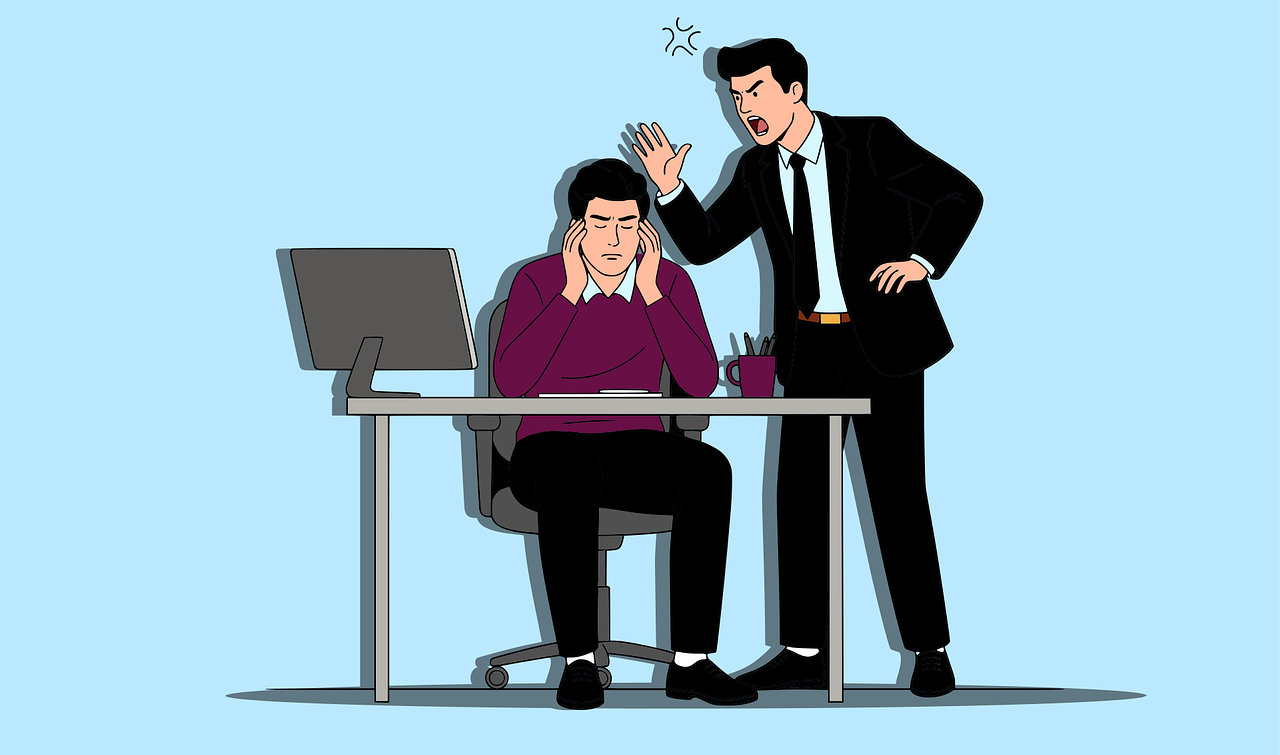

Do you find yourself treating your co-workers, especially your subordinates, badly? You may: exclude and isolate, ignore, threaten, disparage, embarrass or sabotage them. Do you:
- Take credit for their work?
- Yell at them?
- Minimize their concerns?
- Lie about or to them?
- Undermine their work?
- Withhold crucial information from them?
- Give them incorrect information?
- Reduce their job duties (making them less valuable)?
- Prevent them from advancing in their careers?
- Make them feel useless or like they are the problem?
- Set unrealistic expectations of them?
- Unjustly criticize them?
- Make damaging comments to them?
- Attack their insecurities?
Do you take responsibility for your mistakes or automatically blame others?

You may be a workplace bully.
We most often think of children as the main targets of bullying, but it happens to adult employees, too. In both cases, bullies exploit a power imbalance: Just as bigger kids typically pick on smaller ones, in the workplace, bosses are often the aggressors.
If you suspect the bully in your workplace might be you, it may be difficult for you to read this piece. Or you may be sure it doesn’t apply to you, and not take its message seriously. Whatever the case, think about how you behave in the workplace and try to recognize the harm you may be causing.
The Workplace Bullying Institute defines workplace bullying as “repeated, harmful mistreatment of an employee by one or more employees; abusive conduct that takes the form of verbal abuse, (physical and nonverbal) behaviors that are threatening, intimidating or humiliating, work interference or sabotage, or in some combination.”
You may think that what you do is minor and thus may not truly understand the immense harm you may cause your targets and your workplace. (You can learn about some of the effects in the first entry in this series, “Overview of Workplace Bullying.”) But what you do can indeed affect your colleagues.
Workplace bullying can even be a matter of life and death. According to a systematic review published in the journal Public Health, victims of workplace bullying had 2.03 times more likely to report suicidal ideation and 2.67 times higher chance of reporting suicidal behavior.
Why do you engage in bullying behavior? You may:
- Have been bullied as a child and are repeating what was done to you
- View your behavior as asserting your authority
- Feel bad about yourself and feel superior by diminishing others
- Be insecure, worrying that others’ work outshines yours
- Be jealous of your target
- Engage in hostile behavior based on your target’s appearance, behavior, race, religion, education, LGBTQ+ affiliation or disability
Understanding the reasons for your behavior may help you stop abusing people.
Don’t tell yourself that your coworkers are on your side because they stay quiet. They actually may oppose your destructive behavior, be afraid of you or be fearful of losing their jobs. They may want to avoid drawing your bullying on themselves.
You may be getting away with your behavior short-term, but abuse can backfire. What you do may not be illegal, but if it targets a victim’s protected trait — such as gender, race or disability — it could be. Women, African-Americans, and people with disabilities are frequent targets of bullies. Your behavior could result in a costly lawsuit that would embarrass you and your office, damage your reputation and stymie your career.
Ending bullying is in your interest. Your bullying decreases productivity and lowers your colleagues’ morale, negative results that could reflect badly on you as a supervisor. Even if you are not a supervisor, an unhappy workplace can have a negative effect on you. If you treat everyone with the respect and dignity that they deserve, everyone benefits.
You can help yourself and your workplace by:
- Talking with your loved ones
- Getting professional mental health treatment
- Learning a new skill/hobby. A new focus can make you feel better about yourself and make it easier to stop disrespecting your co-workers.
As author William A. Ward wrote, “Courage is what it takes to stand up and speak; it is also what it takes, on occasion, to sit down and listen.” Be courageous. Stop attempting to bolster your sense of self, self-confidence, self-worth and self-esteem by attacking those of others. It is not too late to change yourself for the better. Treat your co-workers with dignity and respect. You can do it. And your grateful colleagues may thank you for it.
Miriam Edelman, MPA, MSSW, is a Washington, D.C.,-based policy professional. Her experience includes policy work for Congress. Miriam’s undergraduate degree is from Barnard College, Columbia University, with majors in political science and urban studies. She has a master’s in public administration from Cornell University, where she was inducted into the national honorary society for public administration. She has a master’s of science in social work (focusing on policy) from Columbia University. She is a commissioner of the DC Commission on Persons with Disabilities. Miriam aims to continue her career in public service. She is especially interested in democracy, civic education, District of Columbia autonomy, diversity, health policy, women’s issues, and disabilities.



Leave a Reply
You must be logged in to post a comment.