


Nobody asked me! Where does resistance to change come from? Exclusion! Not necessarily from being “anti-change” but from being thought of “after the fact.” Being left out. Side-lined. When leaders wonder why resistance to the “new” is getting in the way or exceeds what they had anticipated, it’s likely because a sustainable stakeholder engagement process early in and throughout the change process is missing. And a reminder please: Training isn’t engagement. Neither is a stakeholder “mapping,” a change readiness assessment or “telling” people what’s going to change.
Changing the way you change. Resistance will be the greatest among those who have the greatest stake in the change but whom leaders have not engaged in the change process. At any level. This alone may be a bigger change than the change-at-hand itself! Why? Because when leaders and managers engage (with) stakeholders, they are shifting away from top-down dynamics, the illusion of “being in control,” and “having all the answers” to hearing what others have to say — both affirming and disaffirming views — and even re-framing what the question(s)/change(s) might need to be.
Engaging stakeholders is a process. It’s ongoing and iterative. If embedded in your operating model and culture, it will strengthen how you do business and build staff capability around being adaptive and leaderly from where they sit. Here are five steps you can take:
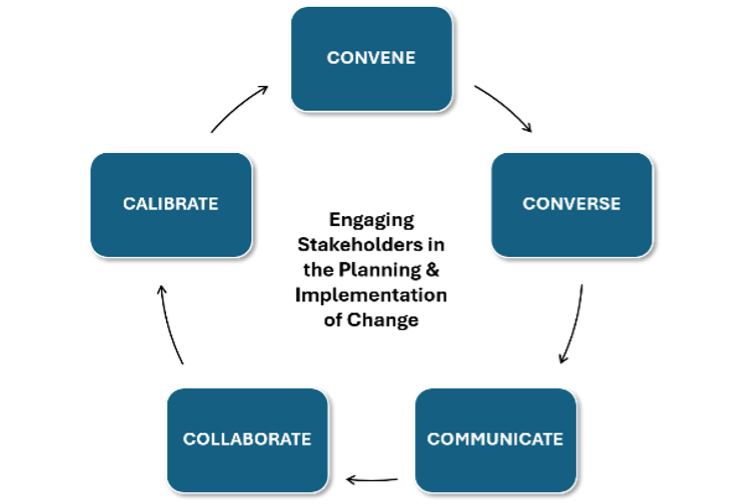
- Bring together the people who have a stake in what’s changing.
- Structure a way for them to talk together about what needs to change.
- Share information broadly about the why — not just the what — and the change process itself.
- Let stakeholders help shape the work.
- Measure, learn and adjust together.
These steps overlap. They’re never really done. Together they power organizational learning and help unify — and actionalize — vision.
CONVENE: Who’s most affected by the change? Bring them together for a series of structured meetings, in person or virtually, to help plan and implement the change.
Keys to success: Clear goals and roles, and agendas that participants can preview and contribute to. They’ll want to know why they are there and have confidence knowing that being there will make a difference.
Good Practice: Convene cross-cutting teams regularly to explore what improvements (changes) are needed in the organization and report out their results and next steps. Make this core to your operating model.
CONVERSE: Is talk about change all send and no receive? Conversations are interactions. Not presenting, “telling,” or announcing. They are upstream – not just downstream. If leaders show up to “sell” a plan they’ve already baked, that’s not conversation.
Key to success: Read-aheads help participants learn and prepare. Everyone needs to be ready to ask — and answer — questions.
Good Practice: Share leadership’s vision and strategic plan. People need to “see” what you see — the big picture — not “just” their slice of it — and right from the start.
COMMUNICATE: Are we sharing information about what’s happening? Let people know! Information-sharing + stakeholder inputs = fewer surprises = less resistance.
Keys to success: Explain the “what” and the “why” of the change. Share what’s happening and what to expect and when. If things change (and they will) – that’s ok – just let people know and open the floor for questions.
Good Practice: Regular updates on meeting goals and outcomes, who’s involved and why, progress along the way, challenges and insights. People like knowing their colleagues and teammates are helping with the change process. That it’s not just top-down but bottom-up. Builds credibility. Confidence. Trust. This is GOOD NEWS!
COLLABORATE: Are those closest to the work helping to shape the change?
NOTE: This may actually be the biggest change in the organization.
Keys to Success: Build multi-functional teams across silos, titles and rank, capabilities and disciplines. Use tools that increase visibility, e.g.: Smartsheet, Teams, AI-powered workspaces, or tech capabilities like model-based systems engineering (MBSE).
Good Practice: Collaboration depends on people making their thinking transparent and freely sharing information and resources. This may be a huge culture shift. For some this could be difficult — even risky. They may feel like they’re relinquishing control. (They likely are …) “Showing” your work makes you vulnerable — it also makes you a much better collaborator — and leader. Leader alert: This practice will alter how performance is managed and how results are measured. See “calibrate.”
CALIBRATE: Question: How will we define success?
Key to success: Stakeholders jointly set measurable outcomes to:
- Increase collaboration, which helps to
- Increase accountability across team, and
- Increase clarity regarding roles and responsibilities, which helps to
- Strengthen processes and hand-offs, which helps to
- Achieve desired results
Good Practice: Performance management “from the bottom up” — not “just” from the top down — increases ownership in the change process and helps mitigate the sense of “victimization” workers may feel when it’s time for their annual assessment. Together, stakeholders can evaluate the change effort to see what is or isn’t working and jointly correct course as needed.
The real leadership shift. The first four steps all start with “co:” they’re about coming together — to meet, talk, share, and work across boundaries. Calibrate keeps things real by helping everyone measure, learn, and adjust — together. Doing change with — not at — people means change isn’t planned in isolation and announced later. It means creating conditions for those most affected by the change to help shape the change from the start. When leaders leverage the very talents and skills their teams were hired for as part of the change process, people won’t feel like they’re being “done to” by a change they had no say in. Resistance diminishes. Room for learning expands. Compliance fades as real “ownership” grows. And leaders — and their change efforts — succeed.
Nina Kern is principal of InterrogativesWork, LLC, a change advisory service dedicated to helping clients and consultants plan and implement organizational change. She has supported a wide variety of organizational change efforts — from digital transformations and functional re-alignments to the stand-up of enterprise risk management programs, PMOs, performance improvement initiatives, org-wide policy and culture change, and more. She has an MS in Organization Development, an MA in Communications, graduated from both the Johns Hopkins Fellows in Change Management Program and Georgetown University’s McDonough School’s Change Management Advanced Practitioner Program (CMAP), and is ProSci trained. More of Nina’s writings on organizational change can be found on GovLoop,Change Management Review, and Government Executive.
Photo Credit: Anna H, Pexels



Leave a Reply
You must be logged in to post a comment.